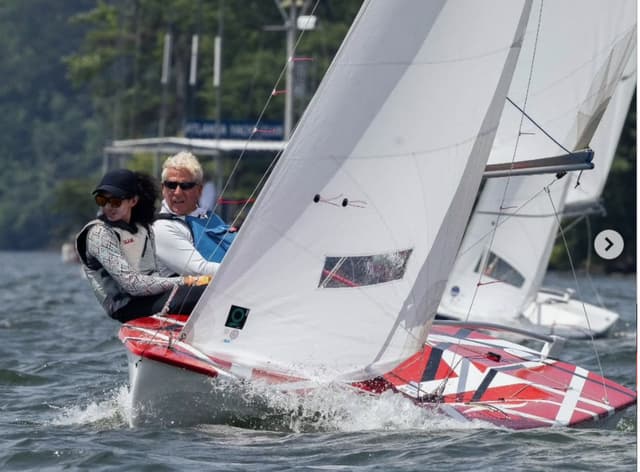
🌊The Downwind / Reaching Leg
Sail adjustments, crew weight, surfing waves, and gybing technique.
The downwind leg is where the crew's active contribution is at its peak — constant weight movement, trim adjustments, wave reading, tactical communication, and boat handling all happen simultaneously. A great downwind crew can gain multiple boat-lengths per leg through superior technique and awareness. This module covers every aspect of downwind and reaching sailing from the crew's perspective.
1. Finding the Right Downwind Angle
The Shroud Telltale Reference
When in doubt about the optimal angle to sail downwind, use this simple visual reference: point the shroud telltale at the forestay. When the telltale streaming off the shroud is aimed approximately at the forestay, you are sailing near the optimal VMG (velocity made good) angle downwind.
- If the shroud telltale points forward of the forestay, you are sailing too high (too much toward a reach) — bear away.
- If the shroud telltale points well aft of the forestay, you are sailing too deep — head up to build apparent wind and speed.
- This reference works as a quick check, but conditions, waves, and pressure will require adjustments. Use it as a baseline, not a rigid rule.
Keeping All Telltales Clear
Downwind, all telltales — shroud, mainsail, and jib — should be monitored and kept clear:
- Shroud telltales: Your primary wind direction reference downwind. Keep them streaming freely — if they wrap around the shroud or get tangled, you lose your best wind angle indicator.
- Mainsail telltales: The leech telltales on the mainsail should stream aft. If they stall (disappear behind the sail), the leech is too tight — ease the vang or mainsheet.
- Jib telltales: With the jib poled out or wing and wing, the luff telltales may not behave normally, but they still provide information about airflow. If the jib collapses or flutters, head up or adjust the pole angle.
2. Mainsail Setup and Trim Downwind
Encouraging Flow Up and Out of the Sail
The goal downwind is to project maximum sail area to the wind and encourage smooth airflow through the sail. This means getting the sail as far out and open as possible:
- Ease the mainsheet: Let the boom out as far as it will go without the sail hitting the shroud. The further out, the more projected area catching the wind.
- Ease the vang to lift the boom: With the vang eased, the boom rises, which rotates the entire sail outward and upward. This encourages airflow up and out of the top of the sail, maximizing power. The sail should look full and round, not flat.
- Pull the mast aft (within limits): On some setups, allowing the mast to rake slightly aft helps the sail project further. However, be careful — too much can risk an inversion (the sail flipping to the wrong side, triggering a death roll). The crew should watch the sail shape and warn the skipper if the sail starts to oscillate.
- Ease the cunningham completely: All cunningham tension should be off downwind to allow the draft to sit in the most powerful position.
- Ease the outhaul: Creating more depth in the lower mainsail adds power downwind.
Vang Management by Condition
- Light air: Vang mostly or fully off. Let the boom rise to lift the sail and project maximum area. The crew or skipper may even manually hold the boom up (within Rule 42 limits) to encourage shape.
- Medium air: Moderate vang — enough to prevent the boom from rising excessively but not so much that it flattens the sail. The leech should twist open at the top.
- Heavy air: Put some vang tension back on. This stabilizes the boom and prevents the mainsail from oscillating wildly, which can destabilize the boat and contribute to death rolls. The vang acts as a damper, keeping the rig more predictable and the boat more controllable.
3. Jib Setup and Pole Work
Easing the Halyard for Better Shape
- Easing the jib halyard downwind allows the jib to sag away from the forestay, creating a deeper, more powerful shape that catches more wind.
- How much to ease depends on conditions — in light air, more ease creates more projected area. In heavy air, less ease keeps the jib more manageable.
- Remember to re-tension before the leeward mark— if you ease the halyard downwind, you must pull it back on before rounding up to go upwind. Add this to your pre-rounding checklist.
Whisker Pole Height and Position
- The whisker pole holds the jib out to windward when sailing downwind. Its height and fore-aft angle directly affect jib shape.
- Pole height: The pole should be set so that the jib clew and tack are at roughly the same height. If the outboard end is too high, the foot is too loose and the leech too tight. If too low, the foot is too tight and the leech too open.
- Pole angle: The pole should be roughly perpendicular to the apparent wind. As you bear off deeper, the pole goes further aft. As you head up on a broader reach, the pole comes forward.
- Jib cloth adjustment: The combination of halyard tension, pole height, and sheet tension determines the jib shape. Experiment during practice to find the fastest settings for different conditions.
4. Reading the Wind — Visual Clues and Indicators
Downwind, reading the wind becomes even more important because shifts and pressure changes directly affect your VMG angle and gybe decisions. Use every available visual clue:
Wind on the Water
- Dark patches (puffs):More wind is coming. "Pressure from the right in 15 seconds — get ready." Puffs downwind mean you can bear off deeper and still maintain speed.
- Light patches (lulls):Less wind ahead. "Going light — head up to keep apparent wind." In lulls, you need to sail higher to maintain boat speed.
- Wind lines: Sharp edges between dark and light water show exactly where the wind changes. Position yourself to sail into pressure and avoid parking in a hole.
Other Boats as Wind Indicators
- Racing boats ahead: Watch their sail angles and speed. If boats ahead suddenly heel more or change angle, a puff or shift is coming your way. If they slow down, a lull is approaching.
- Cruising sailboats: Cruising boats with wind indicators (wind vanes, masthead flies) are excellent real-time wind direction indicators. Their sails also show you the wind angle and strength in their location.
- Powerboats and wakes: The direction spray is blown off a powerboat wake shows the wind direction at the surface.
Shore and Sky Indicators
- Flags and smoke: Flags on shore, smoke from chimneys, or steam from buildings show wind direction at the shoreline. These can indicate a shift coming your way if the shore wind differs from what you are experiencing on the water.
- Trees and vegetation: Watch trees on nearby shores — when they start bending more, wind is building. The direction leaves blow shows the wind angle onshore.
- Clouds: Cloud movement at higher altitude shows the general wind direction aloft. If clouds are moving in a different direction than the surface wind, a shift may be coming as the upper wind mixes down. Dark, building clouds often bring increased wind and shifts.
- Cloud shadows: Dark shadows on the water from clouds can indicate areas of less thermal activity (potentially less wind) while sunlit areas may have more thermal wind.
5. Weight Placement, Pressing, and Stability
Default Weight Position
- Fore-aft: Slightly aft of center. This keeps the bow from burying into waves and allows the boat to surf more easily. The transom should not be dragging, but the bow should be light.
- Athwartships: Crew to windward, extending weight outboard to stabilize the boat. In lighter air, both crew and skipper may be more inboard and centered.
Pressing the Boat Down with Weight
"Pressing" is the technique of using body weight to steer the boat downwind without the rudder, which creates drag:
- Heel to windward: Shifting your weight to windward causes the boat to bear away (turn downwind) naturally due to hull shape. This is faster than using the rudder because there is no rudder drag.
- Communicate:Tell your skipper when you are pressing: "Pressing down" so they can ease the tiller and let the boat respond to your weight.
- When to press: Use pressing to bear off in puffs to ride the extra pressure downwind. Head up in lulls by easing your weight back to center or slightly leeward.
- Coordination with the skipper: The skipper may also be pressing with their weight. Coordinate so you do not overcorrect — one person pressing at a time, or both pressing gently together, depending on what is needed.
Extending Weight for Stability
- In heavy air, extend your weight as far outboard as possible to windward. This provides maximum righting moment and prevents the rolling that leads to death rolls.
- Use the hiking straps and brace your feet for stability. You need to be secure enough that a sudden wave or gust does not throw you off balance.
- Stay athletic and ready to move quickly — weight may need to shift suddenly aft (wave burying the bow) or across the boat (rolling oscillation beginning).
Preventing the Bow from Burying
- This is a critical safety skill. When the bow starts to dig into a wave, shift weight aft immediately — this is not a gradual adjustment, it is an instant reaction.
- A buried bow at speed can lead to a pitch-pole (the stern flips over the bow) or a violent broach.
- Default position slightly aft means you have less distance to move in an emergency. Being too far forward downwind is one of the most common crew errors.
6. Kinetics, Wave Riding, and Coordination
Coordinated Wave Riding
- Call the waves:"Set coming... three... two... one..." Time your weight movement and any legal pumping to catch each wave at the optimal moment.
- Weight aft as the wave lifts: When a wave picks up the stern, shift aft to keep the bow from nosediving as the boat accelerates down the face.
- Weight forward as you surf: Once surfing down the wave face, move weight forward to prevent the stern from settling and losing the wave.
- Rhythmic movement: Wave riding is a continuous, rhythmic motion — back, forward, back, forward — synchronized with the waves. Both crew and skipper should be in rhythm together.
Legal Kinetics (Rule 42)
- One pump per wave: In surfing/planing conditions, one pump of a sail per wave to initiate or maintain surfing may be permitted. Know the current interpretation of Rule 42 for your event.
- Body movement responding to waves: Moving your body in response to wave action (shifting weight to maintain balance and boat trim) is legal. This is different from deliberately rocking the boat to propel it.
- Torso pumping prohibition: Using your torso to pump the sails by repeatedly pulling and releasing is not permitted. The distinction between legal wave response and illegal pumping can be subtle — err on the side of caution.
7. Roll Gybing Technique
The gybe is the primary maneuver downwind, and a well-executed roll gybe can actually gain speed. A poor gybe can cost multiple boat-lengths or lead to a capsize.
Light Air Roll Gybe
- Initiate with weight: Gently heel the boat to windward (the side the boom is on) to start the turn.
- Smooth rotation: The skipper steers slowly while the crew helps the boom across by pulling the mainsheet or vang. In light air, the boom may not swing on its own — you may need to help it.
- Roll to the new side: As the boom crosses, roll the boat to the new windward side. This rolling motion pumps the sails and creates a burst of acceleration.
- Jib handling: Release the pole (or jib from windward) and sheet the jib to the new leeward side. Set the pole on the new side if conditions warrant it.
Medium Air Roll Gybe
- The standard roll gybe is most effective in medium conditions. The process is similar to light air but more dynamic.
- Timing is critical:Initiate the gybe as a wave lifts the stern — the boat is more stable and the turn is easier with the wave's momentum.
- Aggressive roll: Commit to the roll from old side to new side. The energy of the roll accelerates the boat. Both crew and skipper coordinate their weight to drive the roll.
- Boom catch: The skipper catches the boom on the new side with the mainsheet. A free-swinging boom in moderate air is dangerous.
Heavy Air Roll Gybe
- Heavy air gybes are the most dangerous maneuver in dinghy sailing. The key is control and commitment.
- Pre-gybe setup: Ease the vang slightly before the gybe to allow the boom to rise and cross more easily. Sheet the mainsheet in partway to reduce the distance the boom travels.
- Flatten the boat: Do not initiate the gybe with the boat heeled. Get it flat or slightly heeled to windward first.
- Quick, committed turn: The skipper steers firmly. The crew helps the boom across and immediately moves to the new windward side. Hesitation is dangerous — a half-completed gybe in heavy air often leads to a capsize.
- Recover immediately: Once the boom is on the new side, get weight outboard on the new windward side immediately. Re-tension the vang. Get the boat flat and under control before adjusting anything else.
Downwind Sailing Technique — Body Movement and Kinetics
Watch downwind body movement technique and how crew kinetics affect boat speed off the wind
8. Clearing Weed
Weed on the centerboard, rudder, or keel can dramatically slow the boat. Recognizing and clearing it quickly is an important crew skill:
Recognizing Weed
- Feel:The boat feels "sticky" or sluggish. It does not accelerate as expected in puffs.
- Helm change: Sudden increase in weather helm can indicate weed on the rudder. Sudden decrease in pointing ability can indicate weed on the centerboard.
- Visual: Sometimes you can see weed trailing from the centerboard or rudder when looking over the side.
Clearing Procedures
- Centerboard: Sharply raise the centerboard fully and drop it back down. The sudden movement often dislodges weed. Repeat if needed. The crew typically handles this.
- Rudder: The skipper can sharply wiggle the tiller side to side, or briefly lift and reseat the rudder if the design allows. The crew can also reach back and clear weed by hand if it is visible and accessible.
- Timing:Clear weed during a stable moment — not in the middle of a gybe, wave set, or when near other boats. Communicate: "I'm going to try to clear weed — hold steady."
- Prevention: In weedy areas, raise the centerboard slightly higher than normal to reduce the amount of foil exposed to floating weed.
9. Sailing Near Other Boats and Strategy
Downwind Traffic Management
- Dirty air downwind:A boat directly upwind of you blocks your wind ("wind shadow"). The shadow extends much further downwind than upwind — sometimes 5-10 boat-lengths. Communicate when you are in a shadow: "Boat above us is killing our air."
- Defending position: If a boat is trying to pass to windward, keep your air by matching their angle. If they go higher, you go higher (within reason). If they bear off, match them.
- Passing: To overtake a boat ahead, sail in clear air to one side, build speed, then use that extra speed to surf past them. Avoid sailing directly behind boats.
- Leeward mark approach:Establish inside overlap before the zone (3 boat-lengths from the mark under current rules). The crew should be watching for overlaps: "We have overlap — we get mark room."
Strategic Decisions
- Which side to favor: Just like upwind, one side of the course may have more pressure or a favorable shift. Communicate what you see to help the skipper choose which gybe to be on.
- Covering vs gaining: If protecting a lead, stay between the boats behind and the next mark. If trying to catch up, take a different angle to separate and look for opportunities.
- Risk management: Near the end of a downwind leg, conservative sailing protects positions. Earlier in the leg, there is more room for aggressive angles.
Rule 15 — Acquiring Right of Way: When you acquire right of way (e.g., by establishing a leeward overlap), you must initially give the other boat room to keep clear.
Rule 18 — Mark Room:At the leeward mark, boats overlapped when entering the zone must be given mark room by outside boats. The crew's job is to track overlaps and communicate them.
10. Questions
❓ Questions for Your Skipper or Coach
Write down any questions that come to mind as you study this module. They'll be saved here for you to bring up at your next practice or meeting.
11. Knowledge Check
📝Module 7 Quiz — The Downwind / Reaching Leg
Test your understanding of this module.
When in doubt about the correct downwind angle, what reference should the crew use?
Why is it important to lift the boom as high as possible downwind with the vang eased?
In heavy air downwind, why might you put some vang tension back on?
How does easing the jib halyard help downwind speed?
What is the key technique in a roll gybe?
How should the crew help 'press' the boat downwind using body weight instead of rudder?
What is the best procedure for clearing weed from the centerboard or rudder while racing?
When the bow starts to bury into a wave downwind, what should the crew do immediately?