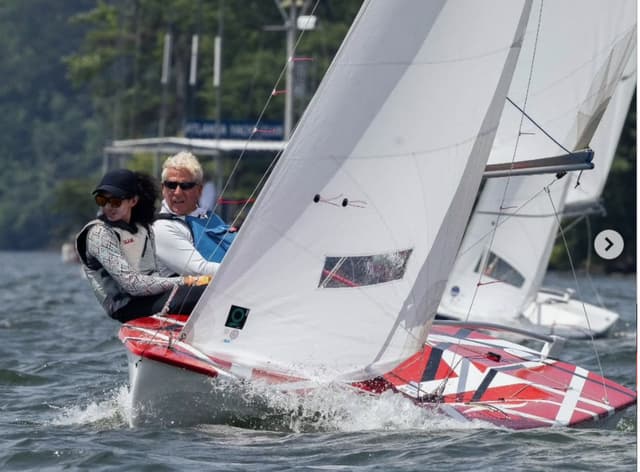
🔄Rounding the Weather Mark
Approach, communication, whisker pole prep, and rounding technique.
The weather mark rounding is one of the most complex moments in a race — you are transitioning from upwind to downwind sailing, managing traffic, adjusting multiple controls, and trying to maintain or gain positions. The crew's communication, anticipation, and execution during this transition can gain or lose multiple boat-lengths. This module covers the approach, rounding, and the critical first moments of the next leg.
1. Approaching the Weather Mark — Layline Strategy
The approach to the weather mark begins well before you can see the mark clearly. The crew's communication about layline, traffic, and wind shifts is critical for a clean rounding.
Communicating the Layline
- Distance to the mark:Keep the skipper updated: "Mark is about 20 boat-lengths ahead, 15 degrees above us" or "Getting close — maybe 10 lengths."
- Are we laying it?The most important call near the mark: "I think we can lay it on this tack" or "We're going to be a few lengths short — one more tack."
- Overstanding awareness:Sailing past the layline wastes distance. Call it: "We're above the layline now — every second we keep going is distance lost."
- Wind shifts near the mark:A shift can change the layline dramatically. "Wind just shifted left 5 degrees — we might be able to lay it now without another tack."
Footing Mode to Pointing Mode Transition
As you approach the layline, you may need to transition from footing (building speed) to pointing (maximizing height):
- When to switch: When you are near the layline and need every degree of pointing to round the mark cleanly. The crew tightens jib trim, hikes harder, and keeps the boat as flat as possible.
- Communicate the transition:"Trimming for pointing — let's squeeze up to the mark" so the skipper knows you are both in the same mode.
- Don't pinch too early: Switching to pointing mode too far from the mark can kill speed and leave you short. Time it for the final approach.
2. Managing Traffic at the Weather Mark
Tacking Above or Below Another Boat
As boats converge on the weather mark from both tacks, you often need to decide whether to tack above (to windward) or below (to leeward) of a converging boat:
- Tack above: Gives you the windward, controlling position. The other boat must sail in your dirty air. Best when you have enough speed to complete the tack and establish position before the other boat reaches you. Risk: if you are slow out of the tack, the other boat rolls over you.
- Tack below: Safer, lower-risk option. You protect your lane and sail in clear air below the other boat. Best when the other boat has clear right of way or will cross ahead regardless. You give up the controlling position but maintain speed.
- Crew's role:Communicate the converging boat's position, speed, and distance: "Starboard boat, three lengths, fast — I don't think we can cross. Tack below?" or "We can cross easily — keep going."
Slowing or Steering to Avoid Boats
- In crowded roundings, you may need to slow down or alter course to avoid a collision or give mark room.
- Crew helps slow the boat: Ease the jib slightly, shift weight aft to drag the transom, or back the jib briefly.
- Watch for boats with mark-room rights:Communicate who has rights: "That boat is overlapped — they get mark room."
- Stay calm in traffic: Crowded roundings are stressful. Clear, calm communication prevents mistakes. Call out boats by position and intent, not with panic.
3. Sail Trim Through the Rounding
The weather mark rounding requires rapid sail adjustments as you transition from close-hauled to a reaching or downwind course. The crew plays a critical role:
Before the Mark (Final Approach)
- Maintain upwind trim until you actually begin turning at the mark. Do not ease sails early — every second of pointing counts.
- Prepare mentally for the sequence of tasks coming up. Know what you need to do and in what order.
- If your skipper asks, pre-tension the vang for the downwind leg while still approaching the mark (if you can do so without compromising upwind trim).
At the Mark (During the Turn)
- Ease the jib: As the boat bears away around the mark, ease the jib sheet progressively to match the new course angle. Do not dump it all at once — match the ease to the turn.
- Vang on: If not already set, ensure the vang is tensioned as the mainsheet eases. The vang controls the boom height and leech tension off the wind.
- Weight shift: Move inboard and aft as the boat bears away. Keeping weight too far outboard through the rounding can heel the boat to windward as the apparent wind shifts.
After the Mark (First 30 Seconds)
- Get the sails trimmed for the new course immediately — the jib should be at its downwind/reaching trim as fast as possible.
- This is the highest-priority moment. Get the boat moving fast in clear air before anything else.
4. The Ladder of Tasks at the Offset
After rounding the weather mark, there are many things to do. Trying to do them all at once leads to a slow, disorganized boat. Instead, follow a priority ladder — top tasks first, then work down:
Task Ladder — Weather Mark to Downwind Leg
- 1 - CRITICALFind a lane and sail for maximum speed. Get the sails trimmed for the new course. Clear air is the priority. If you are in dirty air from boats ahead, work to find a lane — bear off, head up, or position to get clean wind.
- 2 - CRITICALTrim sails for the course. Jib eased to proper downwind trim. Mainsheet eased. Vang set. Both sails pulling for the new angle.
- 3 - HIGHCenterboard up. Raise the centerboard to the appropriate downwind position to reduce drag. This is a quick, high-impact task.
- 4 - HIGHWhisker pole set (if applicable and conditions warrant). Getting the pole out and the jib flying properly adds significant downwind speed.
- 5 - MEDIUMFine-tune pole position and halyard tension. Once the pole is set, adjust its height and fore-aft angle for optimal jib shape. Adjust jib halyard if needed for the downwind trim.
- 6 - MEDIUMCunningham and outhaul adjustments. Ease the cunningham off the wind. Outhaul may be eased slightly for more power in the lower main.
- 7 - LOWAssess tactical situation. Now that you are set up and fast, look around. Where are competitors? What is the wind doing? Where is the next mark? Start communicating tactical observations.
5. Downwind Communication and Awareness
Calling Pressure and Wave Opportunities
- Pressure:Just like upwind, watch for dark patches of wind on the water. "Puff coming from the right in 10 seconds" or "Looks like more pressure on the left side of the course."
- Waves:Downwind, waves become opportunities for surfing. Call out good waves: "Nice set coming — get ready to catch it" or "Wave in three... two... one... go!"
- Lulls:"Going light — head up to keep the apparent wind up" or "Lull ahead, this might be a good time to gybe to the pressure on the right."
Compass Monitoring — When to Gybe
- Monitor the compass downwind just as you do upwind. Note your target heading for the downwind mark.
- Shifts:If the wind shifts so that the other gybe is more direct to the mark, communicate: "We're heading 15 degrees low of the mark on this gybe — other gybe looks better."
- VMG angle: Help track whether you are sailing at the optimal angle — too deep loses VMG, too high wastes distance. The compass helps you stay in the groove.
- Persistent vs oscillating shifts: If the wind is oscillating, gybing on shifts (like tacking on headers upwind) gains distance. If the wind is persistent, favor the gybe toward the new wind direction.
Threatening Boats
- Boats behind:Who is gaining? Are they on a different angle? "Boat behind us is sailing higher and faster — they may roll over us if we don't respond."
- Boats ahead:Are they pulling away or are you closing? "We're gaining on the two boats ahead — keep doing what we're doing."
- Boats on the other gybe:Will they cross ahead or behind after a gybe? "If they gybe now, they cross us. Let's gybe first to protect."
- Converging at the leeward mark:As boats approach the gate or leeward mark, inside overlap becomes critical. "We have overlap on the boat ahead — we get mark room."
6. Body and Trim Kinetics in Waves Downwind
Downwind sailing in waves offers the greatest opportunity for crew-driven speed gains through active body movement and trim:
Surfing Technique — Crew's Role
- Weight aft as the wave arrives: As a wave lifts the stern, shift weight aft to keep the bow from burying into the wave ahead. This helps the boat accelerate onto the wave face.
- Weight forward down the wave: As you surf down the face, shift weight forward to keep the bow from rising and losing the wave. The goal is to stay on the wave as long as possible.
- Jib pumping (where legal): In conditions where Rule 42 allows pumping (typically when surfing conditions exist), one pump of the jib per wave can help the boat catch and stay on a wave. Know when this is permitted — it varies by wind speed and wave conditions.
- Rhythmic body movement: A smooth, rhythmic fore-and-aft weight shift synchronized with the waves keeps the boat surfing. This should feel natural, like riding a bicycle over rolling terrain.
Trim Adjustments for Waves
- Ease in the puffs: When a puff hits downwind, the apparent wind shifts aft. Ease sheets to match the new angle and prevent the boat from rounding up.
- Trim in the lulls: When the wind drops, the apparent wind shifts forward. Trim in to maintain drive.
- Work with the skipper: The skipper heads up in lulls (to keep apparent wind) and bears off in puffs (to ride the pressure). Your trim adjustments should mirror these course changes.
Tacking and Gybing Technique — Jon Emmett
Olympic coach demonstrates the transitions between upwind and downwind sailing — key skills for mark rounding
7. Hitting a Mark — Penalty Turn Execution
Hitting a mark happens — even to the best teams. What matters is how fast and cleanly you execute the penalty turn to minimize the damage. A well-practiced penalty turn costs 2-3 boat-lengths; a sloppy one can cost 10 or more.
Recognizing and Acknowledging
- If either skipper or crew feels or sees the boat touch the mark, call it immediately: "We hit it" or "Mark touch!"
- Do not debate whether you actually hit it — if there is any doubt, take the turn. The penalty for not taking a turn when you should have is disqualification; the cost of an unnecessary turn is a few seconds.
- The penalty is one complete 360-degree turn including one tack and one gybe (or vice versa). It must be done as soon as possible after the incident.
Executing the 360 — Step by Step
- Communicate the plan:"Penalty turn — going to tack first, then gybe" (or whatever direction is fastest given your current course and traffic). Agree on the direction in one second.
- Initiate the turn: The skipper turns; the crew helps with the jib. If tacking first, hold the jib briefly backed to help pull the bow through the wind quickly.
- Through the tack: Cross the boat fast. Trim the jib on the new side just enough to keep the boat moving — you are not sailing for speed here, you are completing the turn.
- Continue the turn into the gybe: As the boat bears off for the gybe portion, ease the jib to help the boat turn downwind. The skipper manages the mainsheet through the gybe. The crew manages weight to keep the boat balanced.
- Complete the 360: As you come back to your original heading, trim everything back to racing trim as fast as possible. Hike, sheet in, and go.
- Back to racing: Clear your head. The turn is done. Focus on sailing fast and making up the lost distance. Do not dwell on the mistake.
Using the Sails to Speed Up the Turn
- Backed jib for tacking: Holding the jib backed during the tack portion pushes the bow through the wind faster than rudder alone.
- Eased jib for bearing off: A fully eased jib reduces resistance as the boat bears away into the gybe.
- Mainsheet management: The skipper keeps the main trimmed enough to maintain steerage through the turn but not so tight that it stalls the rotation.
- Weight coordination: Move your weight to help the boat turn — heeling to leeward helps the boat head up, heeling to windward helps it bear away. Use this to assist the rudder through the rotation.
❓ Questions for Your Skipper or Coach
Write down any questions that come to mind as you study this module. They'll be saved here for you to bring up at your next practice or meeting.
9. Knowledge Check
📝Module 6 Quiz — Rounding the Weather Mark
Test your understanding of this module.
When approaching the weather mark on port layline, what should the crew communicate about starboard-tack boats?
What is the 'ladder of tasks' at the weather mark offset?
When should the crew shift from footing mode to pointing mode approaching the weather mark?
If you hit the weather mark, what is the crew's role in executing the penalty turn?
What is the highest priority task immediately after rounding the weather mark?
When approaching the mark and a boat is coming in from the other side, when should you tack above vs below them?
On the downwind leg after the weather mark, when should the crew call for a gybe based on compass reading?
How should the crew use body movement and trim kinetics to surf waves on the downwind leg?