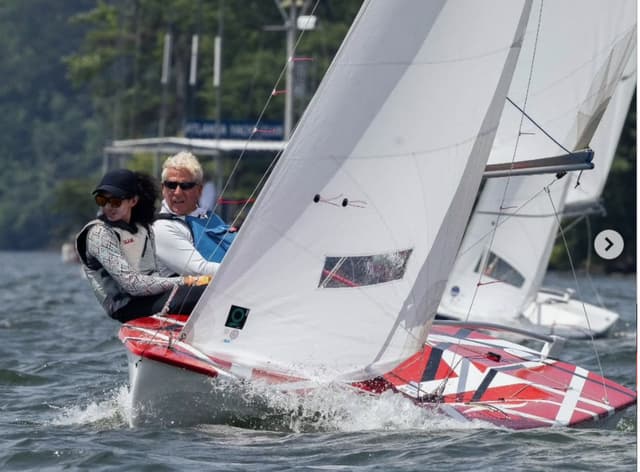
🔔The Starting Sequence
Timing, positioning, line sight, flags and signals, crew communication for a great start.
The start is the most high-pressure moment in a race — and the crew's contribution is enormous. Your eyes, voice, jib handling, weight placement, and ability to stay calm under pressure directly determine whether you come off the line with speed and clear air or spend the first leg digging out of a hole. This module covers everything the crew needs to know about starting.
1. Understanding the Starting Sequence
The standard racing start uses a sequence of flag and sound signals. Both skipper and crew must know these cold:
| Time | Signal | What Happens |
|---|---|---|
| 5 minutes | Warning — class flag raised + sound | Your class is next. Start your watch. Begin reading the line and wind. |
| 4 minutes | Preparatory — P, I, Z, U, or Black flag + sound | Pre-start maneuvering begins. The specific flag determines OCS penalties. |
| 1 minute | Preparatory flag removed + sound | Final minute. Commitment time. Start your approach to the line. |
| 0 minutes | Class flag removed + sound | START! Hike, trim, accelerate. |
Penalty Flags — Know the Consequences
- P flag (Papa): Standard penalty. If you are over the line at the start (OCS), you must return and restart. No additional penalty beyond lost time and position.
- I flag (India): Round-the-ends rule. If you are in the triangle between the line and the first mark during the last minute and are OCS, you must go around one end of the line to restart. More costly than P flag.
- Z flag (Zulu): 20% penalty. If you are in the triangle during the last minute and there is a general recall, you receive a 20% scoring penalty in the restarted race — even if you start correctly in the restart.
- U flag: UFD (Unidentified First Departure). If you are OCS during the last minute, you are disqualified without a hearing — even if there is a general recall.
- Black flag: The most severe. If you are OCS during the last minute, you are disqualified and cannot sail in a restarted race.
2. Starting Strategy — Crew's Role
Choosing the Favored End
The favored end of the starting line is the end that is closer to the wind direction — starting there gives you a geometric advantage. As crew, you help determine the favored end:
- Sighting the line: While the skipper luffs head-to-wind near the middle of the line, you look down the line at both ends. The end that is more upwind is favored. If the line looks square, neither end has a strong advantage.
- Tracking wind shifts: During the pre-start period, actively watch for wind shifts. A shift to the left favors the pin (port) end; a shift to the right favors the committee boat (starboard) end.
- Communicate observations:Tell your skipper what you are seeing — "Wind has shifted left the last two minutes, pin end looks favored" or "Line looks pretty square, I'd say middle to committee boat."
Understanding Line Sag
Line sag is a phenomenon where boats in the middle of the starting line are significantly further from the line than boats at the ends. This happens because:
- Boats in the middle have poor visual references to judge their distance to the line — they can only see boats on either side, not the line endpoints.
- Caution leads middle-of-the-line boats to hang back, creating a bow-shaped gap.
- Boats at the ends (near the pin or committee boat) have clear sightlines to a line endpoint and are typically much closer to the line at the gun.
What this means for you: If you start in the middle of the line, you may need to be more aggressive to avoid being a boat-length or more behind boats at the ends. The crew can help by sighting the line angle and judging distance to the nearest endpoint.
Building a Lane
A "lane" is the clear air space you need to sail fast after the start. Without a lane, you are in disturbed air from boats ahead or to windward, and you lose speed and pointing ability.
- Space to leeward: You want clear water to leeward so you can bear off slightly to build speed without hitting another boat. This means positioning so no boat is close on your leeward side in the final approach.
- Defending your lane:In the final minute, boats may try to squeeze in to leeward. Communicate their approach to your skipper: "Boat trying to come in below us, two lengths back."
- Clear air above: Watch for boats to windward that will blanket you after the start. If a boat establishes itself close to windward and slightly ahead, your air will be disturbed. Flag this to your skipper early.
3. Communication During the Start
The crew is the skipper's eyes and ears during the start. Your communication needs to be constant, clear, and concise. Here is what to call out and when:
5 Minutes to 2 Minutes
- Confirm the preparatory flag: "P flag up" or "I flag — round the ends."
- Wind observations: "Wind is shifting left" or "Steady from 220."
- Line assessment: "Pin looks favored" or "Line is square."
- Fleet observations: "Most boats are setting up at the committee boat end."
2 Minutes to 1 Minute
- Time countdowns: "Two minutes... one thirty..."
- Position: "We're about three boat-lengths from the line."
- Boats nearby: "Boat above us, one length. Boat below, two lengths and closing."
- Lane status: "We have a nice lane to leeward" or "Boat coming in below."
Final Minute
- Continuous time: "Sixty seconds... fifty... forty..."
- Distance to line: "Two lengths to the line... one and a half..."
- Acceleration call: "Time to go" or "We need to sheet in and go now."
- Threats: "Boat above luffing, watch out" or "Big gap to leeward, room to bear off."
At the Gun
- "Gun! Go go go!" — confirm the start signal.
- Watch for a general recall flag — "No recall, we're racing" or "General recall — AP flag is up!"
- Check for individual recall (X flag): "X flag up — are we over?"
4. Awareness of Other Boats
The starting area is crowded and chaotic. The crew needs 360-degree awareness:
- Boats to windward: Will they blanket your air after the start? How close are they? Are they more or less advanced to the line than you?
- Boats to leeward: Are they protecting your lane or threatening it? Could they luff you? Are they faster or slower?
- Boats behind: Is someone coming in fast from behind who could take your spot? A boat approaching on port?
- Boats ahead: Is anyone already over the line early? This could signal a general recall or create space as they return.
- Right of way: Know who has rights. On starboard? Leeward boat? Keep your skipper informed so they can make safe, legal decisions.
5. Acceleration — When to Go and How to Help
Timing the Acceleration
The approach to the line requires a careful acceleration. Too early and you are over the line; too late and you are left behind. The crew helps by:
- Counting down time precisely so the skipper can judge when to sheet in and go.
- Judging distance to the line — "two lengths, we need to start building speed now" or "we're close, hold off another five seconds."
- Trimming the jib smoothly as the boat accelerates — pulling in too fast stalls the jib; too slow leaves power on the table.
Hike Hard From the Gun
The moment the start signal goes, the crew's most important job is to hike as hard as physically possible. This is not the time for a gradual build — it is an explosive effort:
- Roll the boat to weather: As you accelerate off the line, aggressively roll the boat flat to weather (windward). This pumps the sails and helps the boat break free from the pack. The transition from slightly heeled to flat creates a burst of acceleration.
- Maximum hiking effort: The first 30 seconds after the start are the most important hiking of the entire race. The boat that comes off the line flat and fast builds a lane; the boat that heels and slips sideways falls into dirty air.
- Jib trim while hiking: You need to hike aggressively and trim the jib perfectly at the same time. This requires practice — your body hiking out while your hands maintain constant contact with the jib sheet, making small adjustments.
6. Using the Jib to Help Steer at Low Speed
Before the start, boats are often moving slowly — holding position, killing time, or maneuvering in tight quarters. At low speed, the rudder is much less effective. The jib becomes a powerful steering tool:
Backing the Jib
- What it does:Pushing the jib to the windward side (backing it) catches wind on the "wrong" side of the sail, which pushes the bow away from the wind (to leeward).
- When to use: When the skipper needs the bow to bear away and the boat is moving too slowly for the rudder to be effective. Common in pre-start maneuvering to turn the boat downwind or onto the desired heading.
- How to do it: Push the jib clew to windward and hold it there. The more aggressively you push it out, the stronger the turning force. Release it smoothly when the bow has turned enough.
Quick Jib Trim for Acceleration
- When the skipper calls to accelerate, sheet the jib in quickly but smoothly. A snapped-in jib stalls; a slowly trimmed jib loses precious seconds.
- Practice the motion: from fully eased to correctly trimmed in one smooth, fast pull. Know exactly where your trim mark is on the sheet so you do not have to look.
Coordinating with the Skipper
- Develop signals or standard calls: "Backing the jib" when you push it to windward, "Sheeting in" when you trim for speed, "Jib free" when you ease to slow down.
- The skipper and crew should be in sync — when the skipper turns the tiller to bear away at low speed, the crew backs the jib simultaneously. This combination is far more effective than either alone.
Tacking Tips from Olympic Gold Medallist Shirley Robertson
Double Olympic gold medallist demonstrates the boat handling skills essential for pre-start maneuvering
7. Recovering from a Bad Start
Not every start goes well. What separates good teams from average ones is how they recover. The crew's attitude and communication are critical in these moments.
The Most Important Rule: Patience
After a bad start, the instinct is to tack immediately to escape dirty air. Resist this urge. Tacking into the fleet without a plan usually makes things worse:
- You may tack into traffic and end up in even more disturbed air.
- You may be forced to the wrong side of the course.
- Every tack costs speed — two bad tacks in the first minute can put you from a mediocre start to last place.
What to Do Instead
- Sail fast in your lane: Even in disturbed air, sail the boat as fast as possible. Hike hard, trim perfectly, and minimize losses.
- Look for opportunities: Watch for a gap to tack into, a favorable shift, or a boat ahead that tacks away and opens up clear air.
- Communicate options:Tell your skipper what you see: "Gap opening to windward in about 30 seconds" or "Boat above us is about to tack, we'll get their lane."
- Discuss before acting:"If we tack now, can we cross that group?" or "I think we should wait for one more boat to tack away before we go."
- Stay positive: A bad start is recoverable. Many races are won from the middle of the fleet after a poor start. Attitude matters — do not spiral into frustration.
8. Over the Line Early (OCS) — How to Return
If you are over the line at the start signal, you must return and restart. This is stressful but happens to everyone. The crew's role in an efficient return is critical:
Recognizing an OCS
- The race committee will display the X flag (individual recall) with a sound signal. Watch for it.
- If you have any doubt about whether you were over, ask your skipper and look at the committee boat for the flag.
- Under I, U, or Black flag, the consequences of being over are more severe — this is when the crew's pre-start line sighting is especially important to prevent an OCS in the first place.
Executing the Return
Returning to restart must be fast but controlled. Here is the crew's role step by step:
- Confirm the OCS:"X flag is up — I think we're over. Let's go back." Quick, calm confirmation.
- Bear off: The skipper will bear away to get back below the line. As crew, ease the jib to help the boat turn and accelerate downwind. Manage your weight — move inboard if needed to keep the boat balanced through the turn.
- Look for a gap:As you head back, look for the fastest path to get behind the line. "Clear gap to leeward of the pin" or "Go through between those two boats — there's space."
- Cross the line:You must get completely behind the line. Communicate when you are clear: "We're behind the line now."
- Re-start: Head back up to close-hauled. Retrim the jib quickly and aggressively. Hike hard. You are now behind the fleet but you need to sail fast and minimize losses.
- Decide: head up or gybe?Depending on where you are relative to the line and the fleet, you may head up directly or gybe to approach from a better angle. Communicate with your skipper: "I think we can head up here and have clear air" or "Better to gybe and come back on port to find a lane."
Keeping the Boat Fast During the Return
- Every second counts. Keep the boat moving at maximum speed throughout the return maneuver — this is not the time for sloppy boat handling.
- Smooth weight transitions through the bear-off and head-up. Jerky movements slow the boat.
- Keep the boat flat — a heeling boat during a return maneuver loses both speed and control.
- Retrim the jib to optimal as fast as possible once back on course. Do not over-sheet in your rush — check the telltales.
Olympic Medal Race — Starting and Upwind Tactics
Watch how Tom Slingsby executes the start and first beat to win Olympic gold in the Laser
9. Questions
❓ Questions for Your Skipper or Coach
Write down any questions that come to mind as you study this module. They'll be saved here for you to bring up at your next practice or meeting.
10. Knowledge Check
📝Module 4 Quiz — The Starting Sequence
Test your understanding of this module.
How does the crew help determine the favored end of the starting line?
What is 'line sag' and why does it matter?
How can the crew use the jib to help steer the boat at low speed before the start?
What does 'building a lane' mean in the context of starting?
What should the crew be communicating to the skipper during the final minute before the start?
What should the crew do immediately at the start signal?
If your boat is over the line early (OCS), what is the crew's role in getting back?
After a poor start, why is patience important before tacking to find clear air?
What are the standard racing flag signals the crew should know for the starting sequence?
When communicating about other boats during the pre-start, what information is most useful to the skipper?